



















Initially, 3D printing was mostly limited to simple parts made from a single material and a single color. Multi-material printing (using dual extrusion, spool management systems, and advanced slicers) has significantly expanded the possibilities.
It is now possible to produce parts that are more cost-effective while integrating multiple functions in a single print.
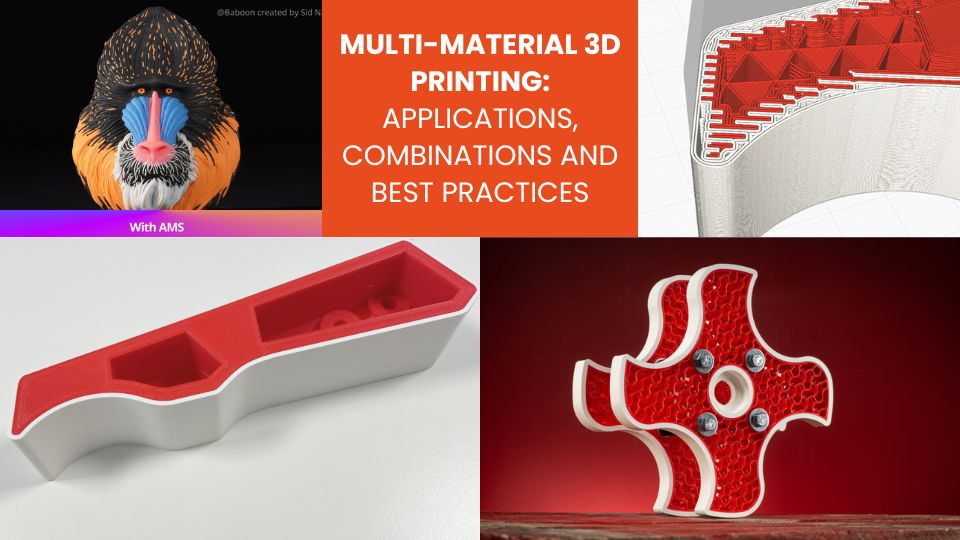
Why print with multiple materials?
Adding several materials to a single part is not just an aesthetic choice. The benefits are numerous:
- Reduced production costs: Some areas of a part can be printed with standard materials (PLA, PETG), while only the mechanically critical zones use smaller amounts of technical filament.
- Time savings and process simplification: Assembling multiple components is no longer necessary. A complete part can be produced in one go, reducing manual operations and the risk of errors.
- Enhanced functional performance: Rigidity, flexibility, chemical resistance, or conductivity can be combined within a single print.
- Greater design freedom: New geometries and integrated functions become accessible without multiplying parts.
Technologies enabling multi-material printing
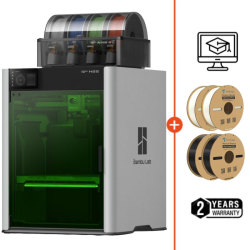
Multi-material 3D printing has become more accessible thanks to advances in extrusion and feeding systems. Independent dual extrusion remains the most common solution. On 3D printers such as the Ultimaker S8 or the Bambu Lab H2D, two separate nozzles deposit different materials precisely, without cross-contamination.
This setup allows combining a rigid filament with a flexible one, or a standard material with a technical polymer, all within the same part.
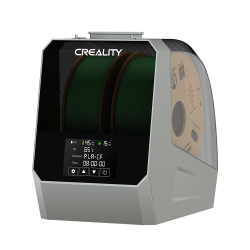
Additionally, automated multi-spool feeding systems have become widespread. The Bambu Lab AMS (Automatic Material System) can manage up to four filaments per unit, and multiple units can be chained for even more combinations. The CFS (Creality Filament System), designed for the K2 series, follows the same logic with automated material switching.
Finally, Anycubic offers the ACE Pro, a similar solution aimed at democratizing multi-material and multi-color printing. These modules reduce operational complexity while making prints more reliable and reproducible.
Practical examples of material combinations and their advantages
Rigid parts + flexible zones
Combining a rigid material like PLA with a flexible filament (TPU or TPE) allows the creation of hybrid parts in a single print.
Example: A protective case with integrated cushioning zones, or a functional hinge without assembly.
Standard materials + reinforced composites
Carbon fiber-filled Nylon is often used to reinforce specific areas of a part while keeping the base in PETG or PLA to reduce overall costs.
Example: A mechanical component requiring a high-strength section, while the rest of the structure remains standard plastic.

Aesthetic + functional
Filaments like PLA Silk or transparent PETG can be combined with a more technical material to merge visual appeal and performance.
Example: A designer object maintaining a translucent section while incorporating a durable internal structure.
Rigid + soluble combinations (specific use)
Although not central, the use of soluble filaments (PVA, BVOH, HIPS) remains useful in certain cases to create geometries that would otherwise be impossible.
However, their role is secondary compared to functional combinations.
Cost reduction and production acceleration
One of the major strengths of multi-material printing lies in its economic impact.
Non-critical areas can be printed with affordable filament, while only strategic sections use premium materials.
Printing multi-material parts in a single step reduces assembly time and eliminates the need for adhesives. Development cycles are shortened: a multi-functional prototype can be produced and tested much faster.
In practice, this allows for a quicker transition from concept to validated product while saving on material.
Technical challenges to consider
Multi-material printing comes with its own constraints:
- Thermal compatibility: Filaments with similar printing temperatures should be selected to avoid defects.
- Inter-material adhesion: Some polymers do not bond well, which can weaken the part.
- Software configuration: Managing purges and transitions is critical for quality.
- Material consumption and cycle time: Each material change generates some waste despite the benefits.
Best practices for getting the most out of multi-material printing
Choose materials wisely: Favor filaments with compatible temperature ranges and shrinkage behaviors.
Test at a small scale: Validate adhesion and interface strength before full-scale production.
Adapt your design: Some areas can be planned from the start to accommodate different materials efficiently.
Store filaments properly: Moisture is a major enemy, especially for Nylon and TPU.
Adjust transition parameters: Optimizing purges and speeds reduces waste and improves interface quality.
Conclusion
Multi-material 3D printing should not be seen only as a way to produce visually richer parts. It represents a true technical advancement that allows multiple functions to be integrated into a single print. It enables cost reduction, time savings, and the exploration of innovative designs.
Although implementation requires a detailed understanding of material interactions, the benefits far outweigh the effort. Multi-material printing is now a strategic tool for transforming 3D printing into a production-ready process that combines aesthetics, performance, and efficiency.
✅ Why Choose Polyfab3D?
Premium Support and After-Sales Service: Starting from your needs, we will guide you to the most suitable solution and provide long-term support for its implementation and daily use.
Official Reseller: Polyfab3D is a certified reseller of top brands, ensuring you get official products, exclusive access to the latest innovations, and priority technical support.
Fast Delivery and Customer Satisfaction: Polyfab3D is committed to providing you with an optimal and fast experience. Positive feedback from our customers rewards us and proves the reliability and efficiency of our service.
Contact us now for a personalized recommendation tailored to your needs, budget, and ambitions.