

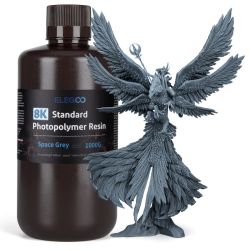
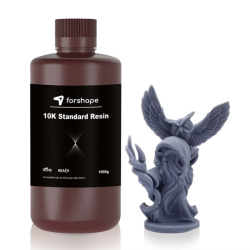





3D printing figurines is no longer reserved for a handful of highly equipped makers: reliable and easy-to-use 3D printers are now accessible to everyone. Today, whether you are a tabletop gaming enthusiast, a collector of miniatures, a miniature painter, or just curious, it is possible to produce pieces at home with an impressive level of detail.
The world of 3D printed figurines has evolved significantly in recent years, both in terms of machines, materials, and post-processing methods.
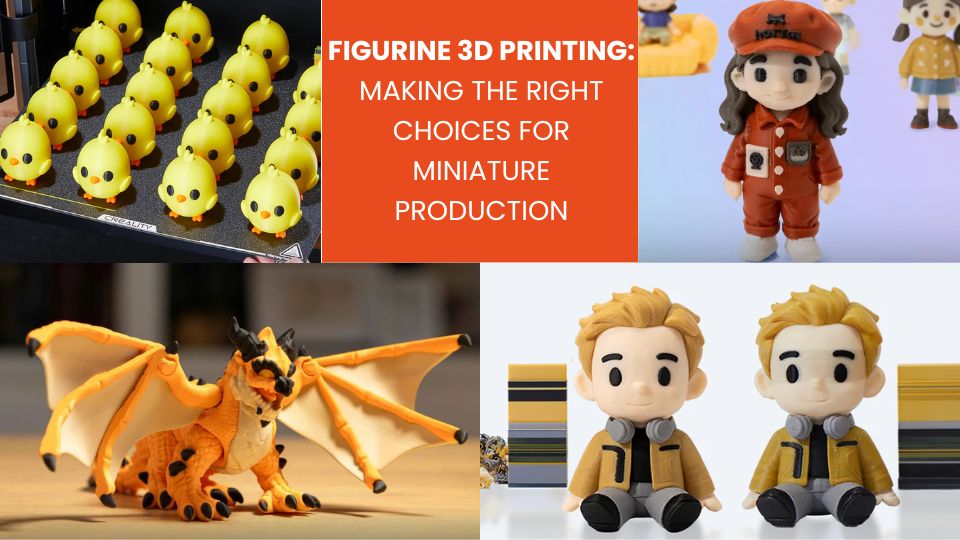
Why 3D printing has become essential for figurines
For a long time, figurines were synonymous with industrial molding or hand-poured resin. 3D printing has disrupted this balance by bringing three major advantages: creative freedom, customization, and accessibility.
Today, it is possible to download or design your own models, scale them precisely, modify a pose or accessory, and then print on demand. For tabletop gamers, this means unique armies. For collectors, pieces unavailable elsewhere. For artists, a new playground for expression.
But be careful: printing a figurine is not just about pressing a button. The choice of technology, settings, and post-processing directly affects the final result.
3D printed figurines: resin or FDM, do you really have to choose?
This is often the first question that arises. And the answer deserves nuance.
Resin: the standard for fine detail
For a long time, resin has been the almost mandatory solution for 3D printed figurines. And for good reason. Resin printers offer exceptional resolution, capable of rendering fine textures, expressive faces, or subtle clothing details.
For small figurines, resin remains the most precise technology today. Layers are thin, surfaces smooth, and layer lines nearly invisible after careful post-processing.
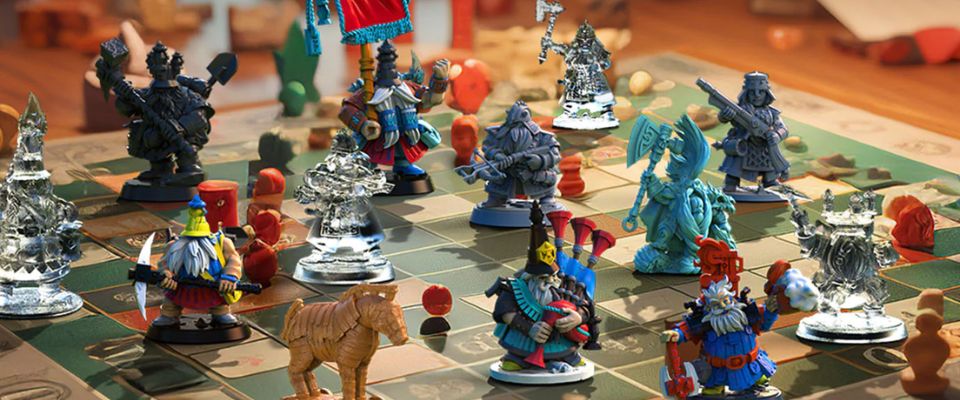
On the other hand, resin requires more rigor: handling specific products, cleaning, UV curing, and support management. It’s not complicated, but it’s not instantaneous either.
FDM: a credible alternative
Long considered unsuitable for figurines, FDM printing has made spectacular progress. Modern machines, combined with fine nozzles, optimized print profiles, and quality filaments, now allow the production of fully usable 3D printer figurines.
FDM is particularly relevant for:
- – large figurines,
- – decorative statues,
- – multi-color projects,
- – pieces requiring good mechanical strength.
Even if raw detail sometimes remains lower than resin, proper settings and post-processing can yield very convincing results.
Choosing the right machine for figurines
The choice of equipment depends primarily on the goal.
If the aim is to produce highly detailed figurines intended to be painted, with a result close to professional molding, resin remains the most logical choice. Prioritize a stable machine with consistent exposure and controlled resolution.
If you want to print larger figurines, stylized characters, or multi-color pieces directly from the printer, FDM becomes a serious option. A well-calibrated machine with rigid mechanics and precise extrusion control makes all the difference.
In any case, the machine alone does not determine the outcome. Settings often matter more than technical specifications.
Our selection of machines for figurines:
| Machine Name | Technology | Strengths for Figurines |
|---|---|---|
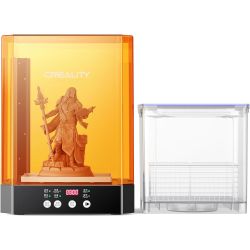
| Creality Halot-X1 | 16K LCD Resin | Exceptional precision, fast printing, excellent automatic resin management |
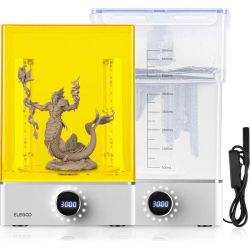
| Elegoo Saturn 4 Ultra 16K | 16K LCD Resin | Very high resolution, temperature control, auto-leveling, Tilt Release |
| Anycubic Photon Mono M7 Pro | 14K LCD Resin | Good speed/quality balance, intelligent vat heating, robustness |
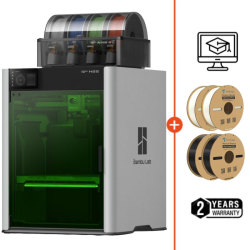
| Snapmaker U1 | Multi-color FDM with Tool Changer | Multi-material and color printing with reduced waste, neat finish on large pieces |
| Creality SPARKX i7 | Multi-color FDM (AI-assisted) | Simplified multi-color printing, easy to use, plugins and visual assistants |
| Creality K2 Combo | Large-format FDM | Generous volume, multi-color options, durable parts |
Quick summary
- Ultra-detailed miniatures: prefer 16K resins
- Unpainted 3D figures: Multicolor machine
Print settings that make a difference
This is where many 3D figurine projects succeed—or fail.
Orientation and supports
The orientation of a figurine directly affects the quality of visible surfaces. In resin, poor orientation can cause support marks on critical areas like faces or hands. In FDM, it affects layer visibility and overall strength.
Taking the time to orient the piece properly often saves hours of rework.
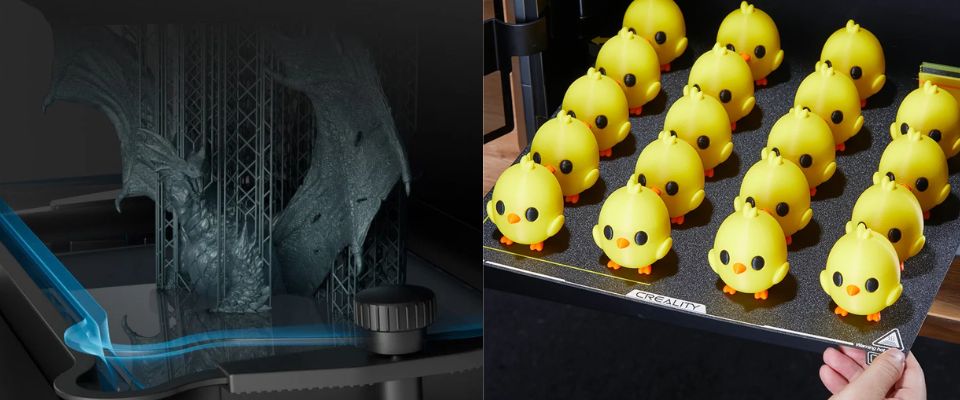
Layer height and resolution
In resin, excessively lowering the layer height does not always yield proportionate visible improvements. In FDM, a fine nozzle combined with a reduced layer height significantly improves the finish, provided the machine is perfectly calibrated.
Speed and stability
Figurines are unforgiving with vibrations. Slightly reducing print speed and prioritizing consistency noticeably improves the final quality.
Post-processing: the key step for a successful figurine
This is probably the most underestimated aspect by beginners. Yet, post-processing transforms a decent print into a truly finished figurine.
Resin
Cleaning must be methodical: rinse, dry, then uniform UV curing. Over-curing can weaken the piece, while under-curing leaves a sticky surface.
Supports should be removed carefully, ideally before full curing.
FDM
Sanding is often unavoidable. Gradually working through the grits helps smooth layer lines without losing details.
Applying a filling primer helps unify the surface before painting.
Painting and finishing: enhancing your printed figurine
A 3D printed figurine truly comes to life once painted. Proper surface preparation greatly facilitates the work and improves the final appearance.
The primer should be even and suited to the material. Then, basic techniques, washes, dry brushing, or airbrushing reveal volumes and details.
Even an FDM figurine can become very convincing after careful painting. Check out our article to learn more about painting PLA.
Conclusion: an accessible yet demanding world
3D printed figurines are now within reach of many enthusiasts. Technologies have matured, machines are more reliable, and methods better controlled.
Resin or FDM, there is no universal solution. What matters is consistency between the project, machine, settings, and the time devoted to post-processing.
With method, patience, and constant attention to quality, 3D printing figurines becomes an exciting field for experimentation, where every project helps you improve.
✅ Why Choose Polyfab3D?
Premium Support and After-Sales Service: Starting from your needs, we will guide you to the most suitable solution and provide long-term support for its implementation and daily use.
Official Reseller: Polyfab3D is a certified reseller of top brands, ensuring you get official products, exclusive access to the latest innovations, and priority technical support.
Fast Delivery and Customer Satisfaction: Polyfab3D is committed to providing you with an optimal and fast experience. Positive feedback from our customers rewards us and proves the reliability and efficiency of our service.
Contact us now for a personalized recommendation tailored to your needs, budget, and ambitions.