













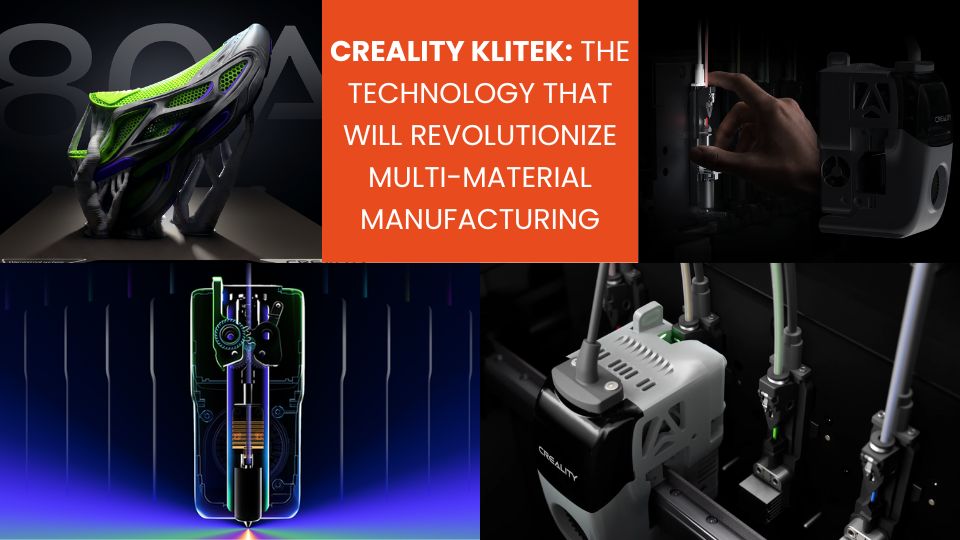
The new KliTek system was recently unveiled by Creality, and here is everything you need to know about this technology, which has been announced as a revolutionary innovation.
Over the past few years, multi-color and multi-material systems have evolved rapidly. Yet despite these advancements, one challenge remains nearly universal: the waste generated during material changes. This is precisely where KliTek aims to offer a different solution.
Presented as a new generation of automatic changeover technology, KliTek is not simply designed to speed up transitions between different materials. Its ambition is far greater: to completely rethink the way these changes are carried out in order to reduce waste, improve efficiency, and unlock new possibilities.
Let’s take a closer look at this technology, which could represent a major turning point in the world of additive manufacturing.
Why Material Changes Remain a Major Challenge
Whenever a system uses multiple colors or materials, one unavoidable step takes place during every transition: purging.
This process involves removing the previously used material to prevent contamination between different colors or material types.
The concept is simple, but its consequences are often significant:
- – increased material consumption;
- – longer production times;
- – the generation of sometimes considerable waste;
- – additional wear on components.
On certain complex projects involving hundreds of material changes, the amount of material discarded can even exceed the quantity used to manufacture the actual part.
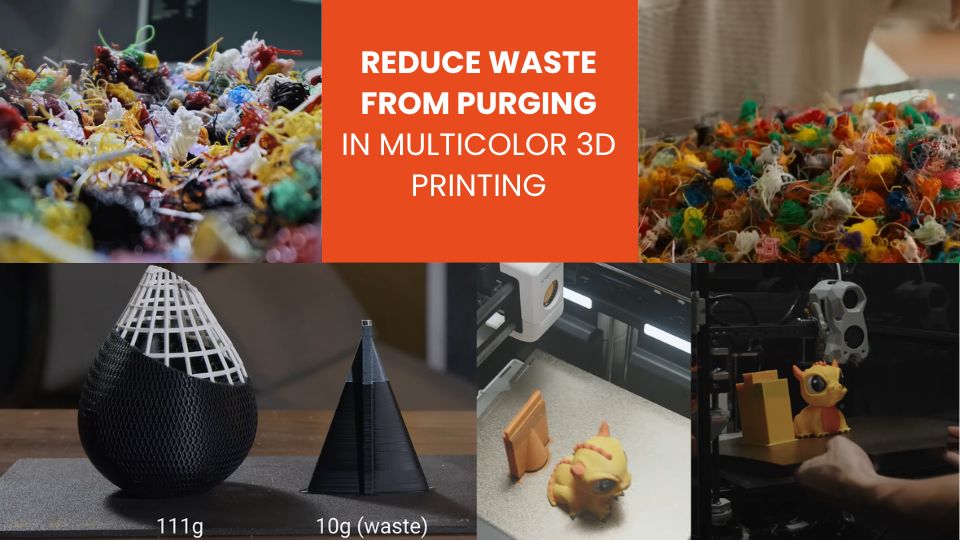
➡️ Read our article on
How to reduce 3D printing waste related to purging?
This reality is now widely accepted as an unavoidable technical limitation. KliTek, however, adopts a radically different philosophy.
KliTek: An Approach That Changes the Rules of the Game
Unlike traditional multi-material systems that feed several materials through a single nozzle, KliTek takes a different approach: each material has its own dedicated module.
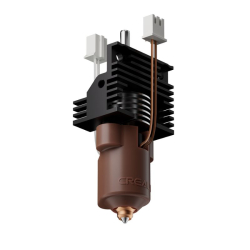
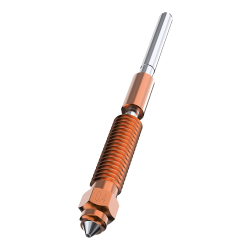
During a material change, the system does not replace the entire printhead like some tool-changing solutions do. Instead, it only swaps the hotend and nozzle module. This architecture helps maintain a lightweight moving assembly while significantly reducing the need for purging.
By isolating each material within its own dedicated path, KliTek minimizes the risk of contamination between colors or materials while speeding up transitions. This innovative philosophy is focused on improving multi-material efficiency while preserving the performance advantages of a lightweight and fast-moving system.
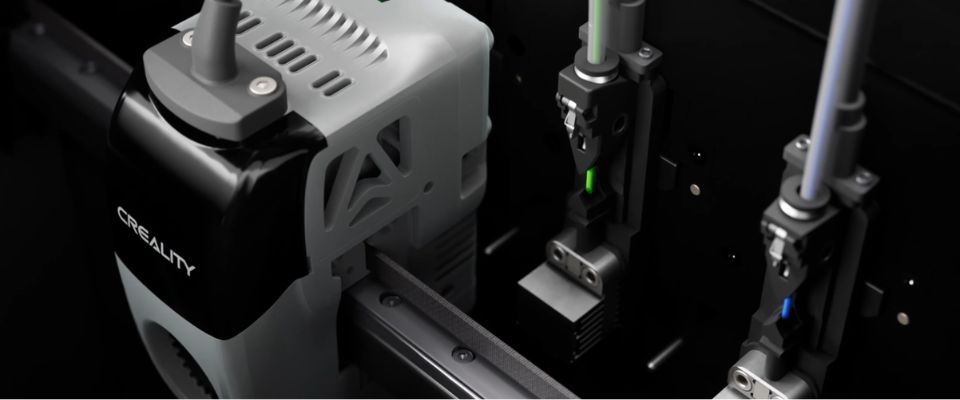
This approach offers several immediate advantages:
- – drastically reduced purging;
- – faster transitions;
- – improved material control;
- – reduced waste generation.
On paper, the concept seems straightforward. However, achieving these changes quickly, accurately, and repeatedly represents a significant engineering challenge.
KliTek Promises Material Changes in Less Than Five Seconds
One of the most discussed figures concerns the changeover speed.
According to the information released, a complete module replacement could be performed in less than five seconds.
If this performance is confirmed under real-world conditions, it would represent a significant advancement.
In environments involving frequent material changes, saving just a few seconds per transition could quickly translate into several hours saved on complex manufacturing projects.
Of course, independent testing will be necessary to determine whether these performances remain consistent over hundreds or even thousands of cycles.
The Real Challenge: Reducing Waste
The speed is impressive, but it is probably not the most important aspect of KliTek.
The primary benefit could be the dramatic reduction in material waste.
Today, multi-color production often generates substantial amounts of waste in the form of purge towers or cleaning blocks. Thanks to its architecture based on independent modules, these losses could be significantly reduced.
For users who regularly produce complex projects, the long-term savings could become particularly attractive.
This reduction in waste is likely one of the strongest arguments in favor of the KliTek concept.
KliTek and Flexible Materials: A Particularly Promising Direction
Among the various applications showcased, one topic appears repeatedly: flexible materials.
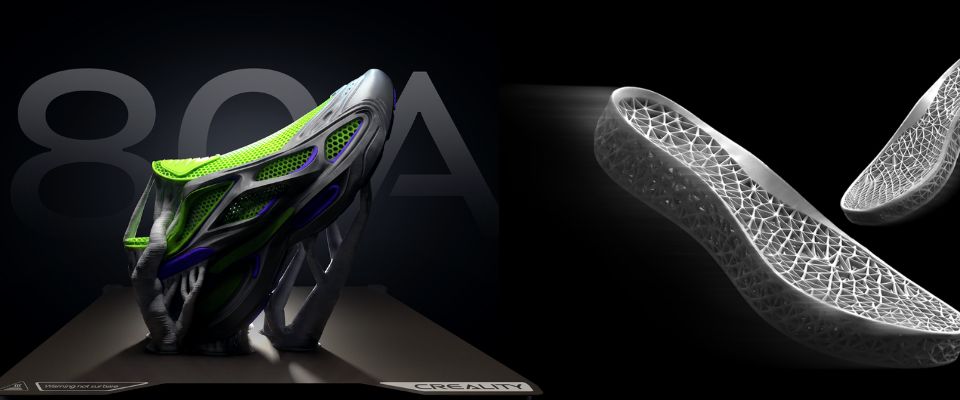
Flexible materials have always represented a technical challenge due to their tendency to compress and deform during feeding. To address this issue, KliTek relies on a unique drive system combining two synchronized mechanisms: one pulls the material while a second assists from the rear.
This approach enables much smoother material movement and significantly reduces the risk of jams or extrusion inconsistencies.
Thanks to this architecture, KliTek is capable of handling extremely soft materials, down to 80A Shore hardness, while maintaining flow rates well above current industry standards. This advancement could open new opportunities for technical components, damping applications, or parts requiring multiple levels of flexibility.
Multiple Nozzle Diameters in a Single Build with KliTek?
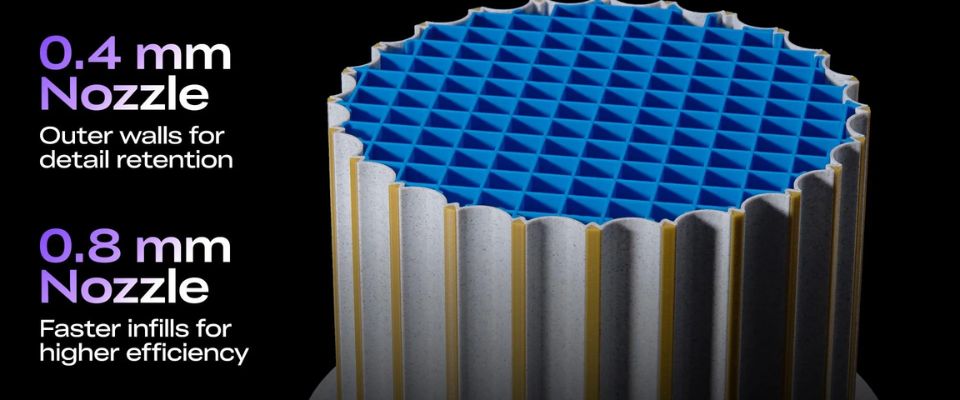
One of the least publicized features may actually be one of the most interesting. Thanks to its independent modules, KliTek theoretically makes it possible to use different nozzle diameters within the same production process.
Why does this matter? Because a large portion of manufacturing time is spent on areas where maximum precision is not required.
A larger nozzle diameter can significantly accelerate certain operations. Conversely, visible surfaces and fine details can still benefit from a smaller nozzle diameter.
This combination could provide an excellent balance between visual quality and production speed.
Precision: An Often Underestimated Challenge
Changing a module quickly is one thing. Repositioning it with perfect accuracy is another. Even a deviation of a few dozen microns can become visible on a complex part.
This is why repositioning accuracy is probably one of the most critical aspects of KliTek. Every module change must return to exactly the same position without any offset.
Creality claims an XYZ repositioning accuracy of less than 25 microns. This represents a particularly demanding mechanical challenge that will require extensive validation in real-world conditions.
Questions That Still Remain Unanswered
Despite the amount of information already available, several uncertainties remain.
Among the most frequently asked questions are:
- – what will be the cost of additional modules?
- – what will their actual lifespan be?
- – what maintenance operations will be required?
- – how many modules can be used simultaneously?
- – what software limitations, if any, will exist?
These questions are important because they will largely determine the real-world adoption of the technology. An innovation can be technically brilliant while remaining niche if its cost or complexity becomes too significant.
KliTek and Market Expectations
The current market environment is particularly favorable to new approaches. Users are now looking for more than just speed.
Waste reduction, versatility, and overall efficiency are becoming increasingly important selection criteria. KliTek appears to address several of these expectations simultaneously.
This ability to solve multiple challenges with a single innovation largely explains the attention it is currently receiving.
An Evolution or a Revolution?
The question is worth asking. KliTek is not simply introducing a new component or an incremental improvement.
The technology challenges one of the fundamental principles behind current multi-material systems.
If its promises are fulfilled, its impact could be comparable to some of the most significant innovations introduced in recent years within additive manufacturing, such as the Bambu Lab Vortek system or the SnapSwap technology found on the Snapmaker U1.
Conclusion: Why KliTek Deserves Our Full Attention
Among the technologies announced recently, KliTek is undoubtedly one of the most intriguing.
Its philosophy is based on a simple yet potentially highly effective idea: replacing the concept of systematic purging with a genuine dedicated module-swapping process.
The potential benefits are numerous:
- – reduced waste;
- – time savings;
- – improved handling of flexible materials;
- – the ability to use different nozzle diameters;
- – enhanced overall efficiency.
Of course, several unknowns remain, and thorough testing will be necessary to evaluate the system’s real-world performance.
However, one thing is already certain: KliTek brings a new perspective to multi-material manufacturing and could have a lasting influence on future generations of automated production systems.
For that reason alone, this technology is well worth watching closely in the months ahead.