




























Choosing the right 3D resin makes it possible to produce highly detailed parts, with smooth surfaces and excellent reproduction of complex geometries. Figurines, functional prototypes, mechanical parts, dental models or industrial applications: the possibilities are extensive.
However, not all 3D resins meet the same requirements. Some prioritise fine details and surface quality, while others are formulated to withstand impacts, tolerate deformation or speed up production cycles. There are also materials specifically developed for technical and professional applications.
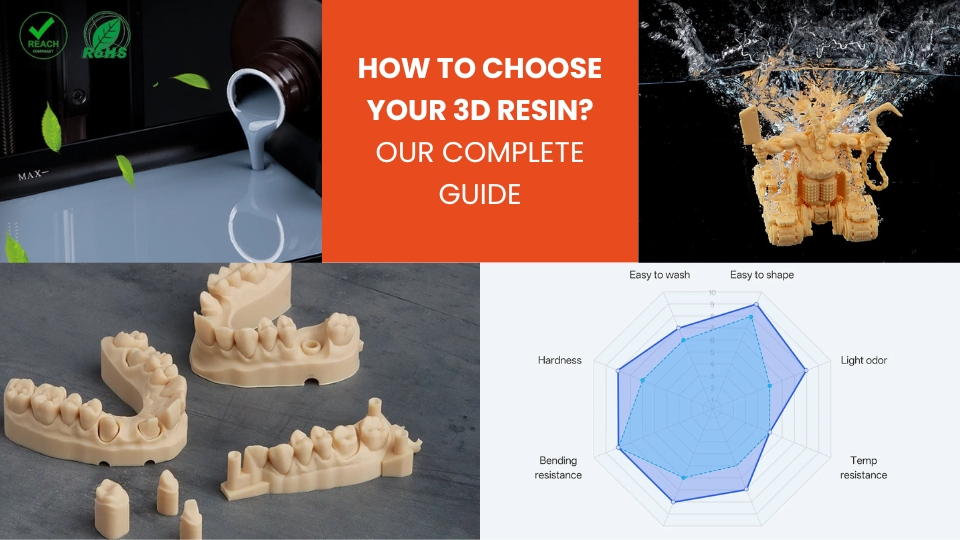
So, which 3D resin should you choose for your project?
The right choice mainly depends on the intended use of the part, the mechanical stresses it will be subjected to and the performance you are looking for.
In this guide, discover the different types of 3D resin, their properties, advantages and limitations. You will also find the technical criteria to consider when selecting a material that genuinely meets your needs.
Which 3D resin should you choose for your application?
Before looking at the technical specifications, here is an overview of the main resin families and their applications.
| Resin type | Recommended applications | Main advantage |
|---|---|---|
| Standard resin | Figurines, models, visual prototypes | Fine details |
| Tough resin | Functional parts, housings, assemblies | Impact resistance |
| High-speed resin | Series production, rapid prototyping | Reduced printing time |
| Flexible resin | Seals, protective components, deformable parts | Elasticity |
| Dental resin | Models, surgical guides, dental applications | Specialised formulations |
Our advice: always start by defining the purpose of your part. A figurine intended for display will not have the same requirements as a mechanical support subjected to repeated stress. The intended application should guide your choice of material.
1. Understanding the criteria for choosing the right 3D resin
A photopolymer resin is a liquid material that hardens when exposed to a light source, usually ultraviolet light. The different formulations available on the market can significantly change the properties of the finished part.
To compare two resins effectively, several technical characteristics deserve particular attention.
Mechanical strength: an essential criterion
Mechanical strength determines a part’s ability to withstand the stresses it will encounter during use.
A rigid resin generally retains its shape well, but may be relatively fragile when subjected to impacts. Conversely, a resin formulated for greater toughness can absorb more energy before cracking or breaking.
Several indicators are available in technical datasheets to assess these properties:
- – Tensile strength (MPa): measures the maximum stress a material can withstand when stretched.
- – Elastic modulus (MPa): indicates the material’s stiffness when subjected to deformation.
- – Flexural strength (MPa): measures its ability to withstand bending forces.
- – Elongation at break (%): indicates how much the material can deform before breaking.
- – Impact resistance: assesses its ability to absorb energy during an impact.
These indicators are not interchangeable. A resin with high tensile strength is not necessarily the one that will offer the best impact resistance.
Flexibility and hardness
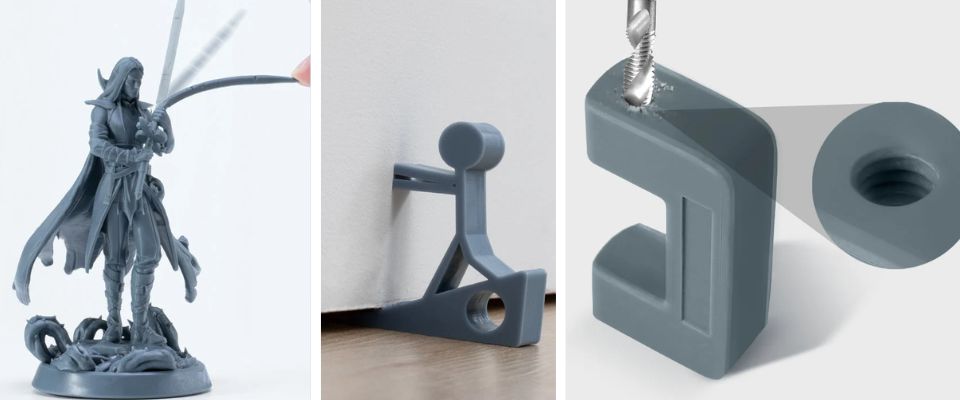
When producing parts that need to deform, absorb vibrations or return to their original shape after pressure is applied, flexibility becomes a key consideration.
Shore hardness is one way of characterising this property. For flexible materials, the Shore A scale is mainly used, while harder materials are generally measured on the Shore D scale.
The lower the Shore A value, the more flexible the material generally is. A Shore 50A resin will therefore be more deformable than a Shore 80A resin.
However, hardness alone is not enough to characterise a resin’s mechanical behaviour. Elongation at break, tear resistance and the ability to recover after deformation must also be taken into account.
Heat resistance
Some printed parts need to retain their properties when exposed to high temperatures.
Two indicators are particularly useful for these applications:
- – HDT (Heat Deflection Temperature): the temperature at which a material begins to deform under a defined load.
- – Tg (Glass Transition Temperature): the glass transition temperature, above which the material begins to behave more flexibly.
These values help assess a resin’s thermal behaviour, but should not be confused with a guaranteed maximum operating temperature.
Accuracy and dimensional stability
Resin 3D printing technology is particularly appreciated for its ability to reproduce fine details and complex geometries.
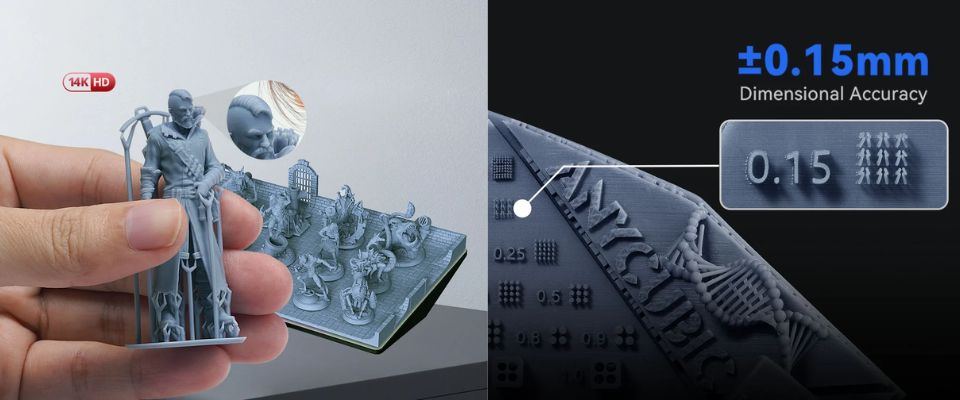
For figurines, miniatures and models, fine detail is often the top priority. For functional parts, you also need to consider polymerisation shrinkage and dimensional stability.
Good dimensional stability helps minimise discrepancies between the dimensions of the digital model and those of the finished part.
Machine compatibility
Before purchasing a 3D resin, check that it is compatible with your machine.
The wavelength of the light source is one of the first things to check. Many resins designed for LCD/MSLA and DLP machines operate at 405 nm, but this is not a universal rule.
You should also check the available printing profiles, recommended exposure times and post-processing requirements.
A resin that performs well on one machine may require different settings on another model.
2. The six main resin families to know
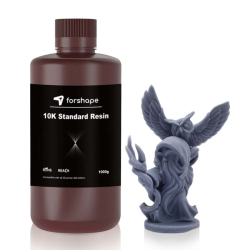
Standard resin: the versatile choice for detailed prints
Standard resin is generally the first material used by people discovering photopolymer 3D printing.
It offers a good balance between ease of printing, fine details and cost. Its formulation makes it possible to achieve smooth surfaces, precise contours and excellent reproduction of small features.
It is particularly suitable when the visual appearance of the part matters more than its mechanical performance.
Main applications:
- – Detailed figurines and miniatures.
- – Architectural models and scale models.
- – Visual prototypes.
- – Decorative objects and collectibles.
- – Models intended for painting or display.
Standard resin does, however, have one limitation: its relative brittleness. Thin parts can break when removing supports or during handling.
It is therefore not recommended for components subjected to repeated impacts or significant mechanical stress.
Key takeaway: choose Standard resin for detailed prints with a good surface finish and no particular mechanical requirements.
Tough resin: improved strength for functional parts
Tough resins, sometimes marketed as ABS-like, are designed to improve the mechanical strength of printed parts.
Their formulation generally provides a better balance of stiffness, toughness and impact absorption than conventional Standard resin.
They are particularly suitable for producing parts that need to be handled, assembled or subjected to moderate stress.
Main applications:
- – Electronic housings and enclosures.
- – Supports and mounting parts.
- – Functional mechanical prototypes.
- – Clips and assembly systems.
- – Parts that are handled regularly.
Please note: the Tough and ABS-like labels do not guarantee identical properties from one manufacturer to another. Some formulations prioritise stiffness, while others offer greater elongation at break.
It is therefore best to compare the mechanical data rather than relying solely on the product name.
Key takeaway: Tough resin is an excellent choice for functional prototypes and parts that require better impact resistance and durability during handling.
High-speed resin: reducing printing times
High-speed resins are formulated to accelerate polymerisation and enable shorter printing cycles.
They are particularly suited to users who want to produce several parts quickly, especially for prototyping or small-batch production.
Their photosensitive formulation is designed for shorter exposure times, provided that a compatible printer and suitable profile are used.
Main applications:
- – Series production of figurines.
- – Rapid prototyping.
- – Production of models and scale models.
- – Repetitive production of small parts.
- – Workshops looking to improve productivity.
One point is worth clarifying: a resin that polymerises quickly does not necessarily guarantee a proportional reduction in total printing time.
Printing speed also depends on build platform movements, the peeling mechanism, layer height and machine settings.
It is therefore important to check the manufacturer’s recommended operating conditions.
Key takeaway: choose a high-speed resin to optimise production rates and reduce printing times, provided you have a compatible machine.
Flexible resin: producing soft and elastic parts
Unlike conventional resins, flexible resins make it possible to produce parts that can deform under stress.
Their behaviour is similar to that of certain elastomers, with flexibility varying according to the formulation and Shore hardness.
They are particularly useful for designing components that need to absorb impacts, dampen vibrations or return to their original shape after deformation.
Main applications:
- – Seals and sealing components.
- – Protective components and shock absorbers.
- – Handles and non-slip surfaces.
- – Elastomer part prototypes.
- – Soft and deformable components.
However, choosing a flexible resin requires looking beyond its Shore hardness. Tear resistance, elongation at break and elastic recovery are also important.
A very flexible resin is not necessarily the most resistant to wear or repeated deformation.
Key takeaway: choose a Flexible resin when your part needs to deform without breaking, with a level of flexibility suited to its intended use.
Dental resins: materials designed for dental applications
The dental sector uses dental resins specifically formulated to meet the requirements of dental laboratories and practices.
These materials can be used to manufacture various models and devices, with properties suited to each specific indication.
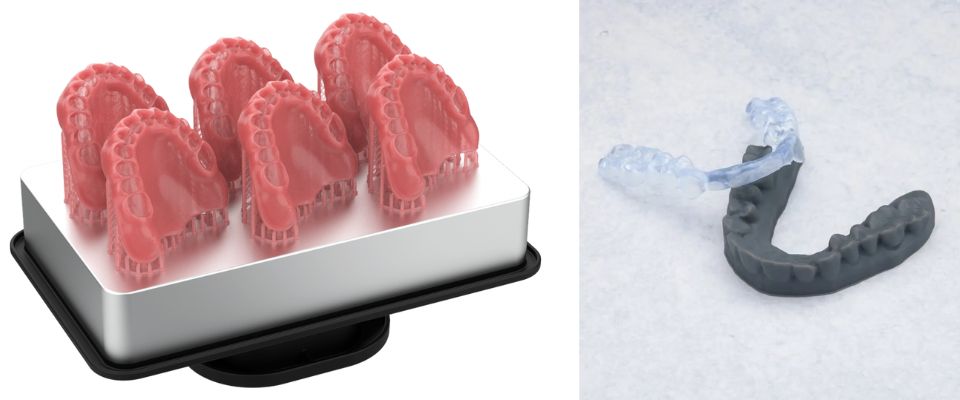
These include:
- – Dental model resins: designed to reproduce dental structures and arches.
- – Surgical guide resins: used to manufacture positioning guides for certain procedures.
- – Orthodontic resins: developed for specific orthodontic applications.
- – Gingival mask resins: used to reproduce gingival tissue on certain models.
- – Castable resins: used to produce patterns intended for casting in certain prosthetic applications.
Biocompatibility is essential for materials intended to come into contact with human tissue. A dental resin should not automatically be considered biocompatible for every application.
It is essential to check the approved indications, applicable certifications and manufacturing and post-processing protocols.
Key takeaway: dental resins are specialised materials that must be selected according to the precise clinical application and its associated regulatory requirements.
3. Comparison table: which material for which application?
To make your choice easier, here is a summary of the six resin families.
| Family | Impact resistance | Flexibility | Main application |
|---|---|---|---|
| Standard | Generally low | Low | Figurines and models |
| Tough | Improved | Variable | Functional parts |
| High-speed | Varies by formulation | Variable | Rapid production |
| Flexible | Varies by formulation | High | Seals and protective components |
| Dental | Depends on indication | Depends on formulation | Dental applications |
The resistance levels are deliberately qualitative, as they can vary significantly between products. For an accurate comparison, consult the technical datasheets of the materials.
4. Choosing and using your 3D resin correctly
Choosing the right material is the first step. To produce high-quality parts and make the most of the resin’s properties, you also need to master the main stages of the printing process.
Preparing and configuring your machine
Before each new print, check that the settings you are using match the selected resin.
Exposure times, layer height, operating temperature and build platform movements all have a direct impact on the result.
It is recommended to start with the profile provided by the manufacturer, then carry out calibration tests to fine-tune the settings.
A different resin may require specific exposure times, even on a machine that has already been perfectly calibrated.
Washing parts correctly
Once printing is complete, parts generally have liquid resin residue on their surface.
Cleaning is required to remove this residue before final curing. Depending on the material, washing is carried out using isopropyl alcohol or a suitable cleaning solution.
Follow the manufacturer’s recommendations to avoid insufficient cleaning or excessive exposure to the solvent.
Performing final UV curing
After washing and drying, additional curing is generally required.
This step completes the hardening process and helps achieve the expected mechanical properties.
The exposure time depends on the formulation, the geometry of the part and the equipment used. Technical and dental resins may require particularly precise protocols.
Inappropriate post-processing can affect the material’s mechanical performance.
Following safe handling precautions
Uncured liquid resin requires special precautions. It is recommended to wear suitable gloves and protective eyewear, work in a properly ventilated area and avoid any contact with the skin.
Resin residue and contaminated cleaning products must be disposed of in accordance with safety instructions and applicable regulations.
5. Mistakes to avoid when choosing your 3D resin
Several mistakes are common when selecting a material.
Choosing based on price alone: an expensive resin is not necessarily the best choice for your project, just as an affordable resin may perfectly meet your needs. It all depends on the intended application and the properties you are looking for.
Confusing stiffness with strength: a very rigid resin can be brittle. For functional parts, also consider toughness and impact resistance.
Relying solely on commercial labels: Standard, Tough, ABS-like and Flexible do not correspond to commonised performance levels shared by all manufacturers.
Overlooking compatibility: always check the wavelength, printing profiles and recommendations for your specific machine model.
Forgetting about post-processing: washing and UV curing are integral parts of the process. They determine the final properties of the part.
6. FAQ: frequently asked questions about choosing 3D resin
What is the best resin for a 3D printer?
There is no single best resin for every application. Standard resin is ideal for figurines and models, while Tough resin is better suited to functional parts. For flexible components, Flexible resin is the better option. The choice therefore depends on the intended application and the required mechanical properties.
What is the difference between Standard resin and ABS-like resin?
Standard resin generally prioritises fine details and surface quality. ABS-like resin is formulated to offer tougher mechanical properties, with improved impact resistance and durability during handling. Exact performance varies between manufacturers.
Which resin should you choose for mechanical parts?
For mechanical parts, Tough resin or a technical resin is generally more suitable than Standard resin. You should consider tensile strength, flexural modulus, elongation at break and heat resistance, depending on the operating conditions.
Which 3D resin should you choose for figurines?
Standard resin is generally the best choice for printing figurines. It reproduces fine details, textures and small features with a good surface finish. A high-detail formulation may also be worth considering for particularly intricate models.
Can you use any resin with an LCD machine?
No. You need to check compatibility between the resin, the wavelength of the light source and the technology used. Many LCD/MSLA resins operate at 405 nm, but some formulations require different exposure conditions.
Which resin should you choose for flexible parts?
Flexible resin is designed to produce deformable and elastic parts. Shore A hardness, elongation at break and tear resistance can be used to compare different formulations according to the required level of flexibility.
Which 3D resin offers the best heat resistance?
High-temperature resins are specifically formulated to retain their properties in demanding thermal environments. To compare them, look at their HDT and glass transition temperature. Also check the testing and post-processing conditions.
Are all dental resins biocompatible?
No. Biocompatibility depends on the formulation and intended application. A resin designed to print a study model does not necessarily have the properties required for a device that comes into contact with human tissue. Always check the manufacturer’s certifications and stated indications.
Conclusion: choosing your 3D resin according to your project
Choosing a 3D resin is first and foremost about identifying the properties required in the finished part. Fine details, impact resistance, flexibility, production speed or technical requirements: each resin family meets specific needs.
- – Standard: for detailed prints, figurines and models.
- – Tough: for functional prototypes and durable parts.
- – High-speed: to optimise production times.
- – Flexible: for soft and deformable parts.
- – Dental: for specialised dental applications.
Take the time to compare technical datasheets, check compatibility with your machine and identify the stresses your parts will be subjected to.
Unsure which resin to choose? The Polyfab3D team can help you select the right consumables and 3D printing equipment, with advice tailored to your projects and requirements.